

The Intelligent Money Letter | 28 October 2026
Imagine a successful business owner who has done everything expected of a responsible wealth creator: built the business, acquired investments, purchased property, arranged insurance and prepared a will.
The documents are in order. But one day the family must act without the person who made most of the financial decisions.
Which liabilities need attention first? How much liquidity is available without disrupting long-term assets? Who is authorised to approve a major commitment? Which investments are suitable to hold, and which risks were being managed quietly for years?
The family may know what it owns without knowing how to manage what it owns.
This is the often-overlooked difference between wealth transfer and wealth continuity.
The size of the transfer is not the measure of preparedness
A Julius Baer–EY report published in August 2026 estimates that US$1.3–1.5 trillion could pass between generations in India over the coming decade.
A separate global Family Barometer from Julius Baer and EY, published on 20 October 2026, found that only 2.3% of ultra-high-net-worth business-owning families were considered fully ready for a sale or transfer. That finding reflects assessments gathered from wealth professionals rather than a direct census of families.
These figures cover different populations and should not be compared mathematically. Together, however, they raise an important question: as wealth changes hands, is the ability to govern it changing hands too?
Three things that should not be confused
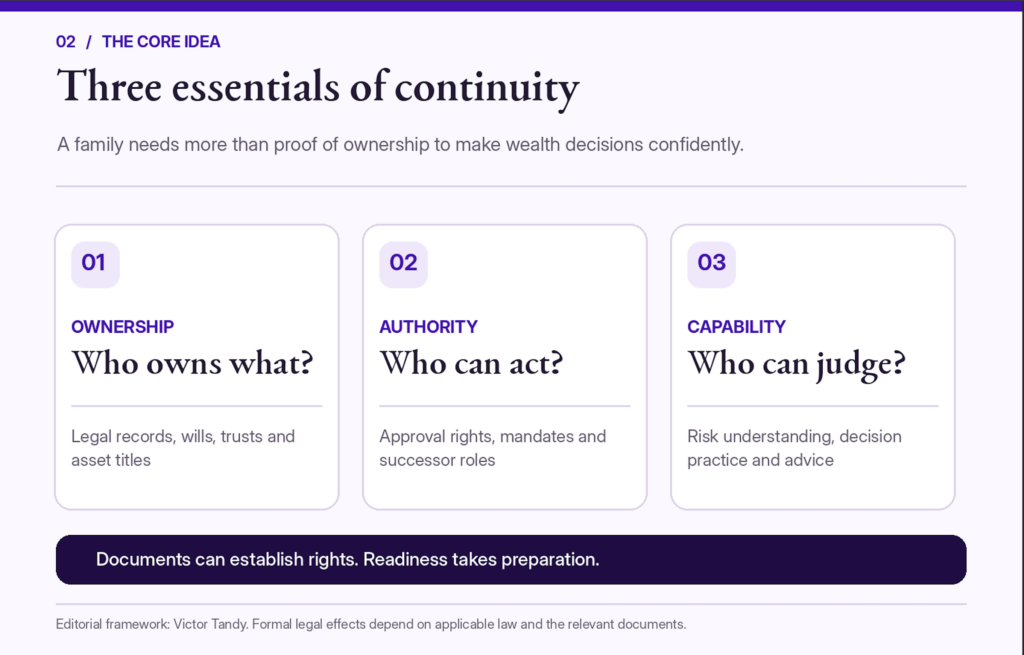
Ownership determines who holds or benefits from an asset, subject to the relevant legal arrangements.
Authority determines who may make specific decisions, sign documents, approve transactions or represent an entity.
Judgment determines whether those decisions are prudent: how much risk is acceptable, when liquidity matters more than return, how to weigh competing family priorities and when professional guidance is needed.
Legal documents and governance records can establish ownership rights and formal powers. They cannot automatically develop investment literacy, resolve disagreements or teach successors to make decisions under pressure.
This difference is especially important when a family’s wealth is spread across operating businesses, property, financial investments, loans, guarantees and multiple jurisdictions. A list of assets may be accurate and still tell an incomplete story of the family’s financial exposure.
Why next-generation preparation often gets delayed
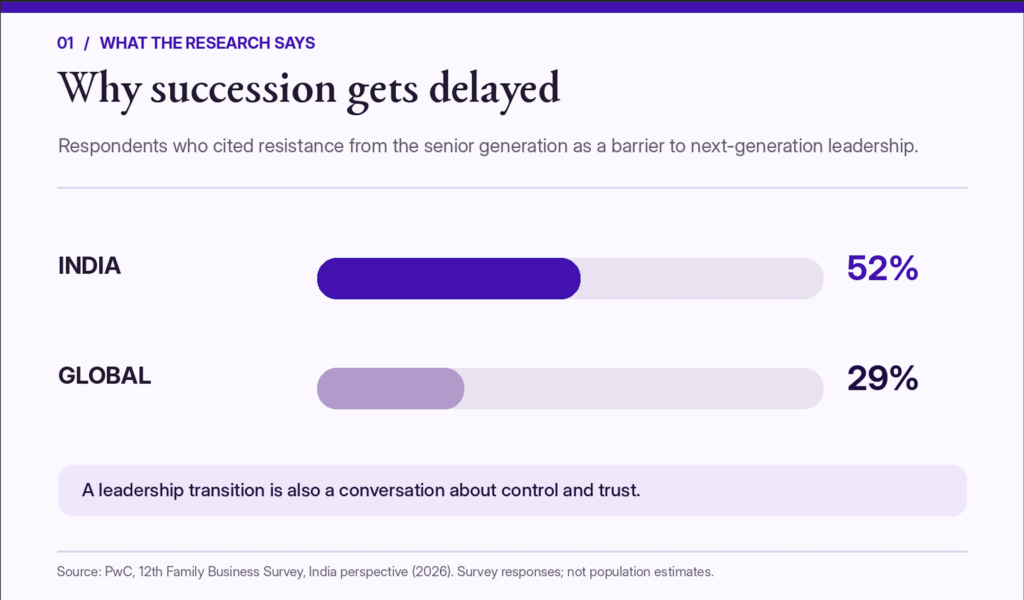
PwC’s 2026 Family Business Survey found that 52% of its Indian respondents identified resistance from the senior generation to transferring leadership as a challenge, compared with 29% globally.
The Indian responses came from a relatively small sample of approximately 40 leaders, so this should be read as a directional insight, not a national estimate.
There is a practical tension underneath that finding. Wealth creators often want to protect what they have built, but protection can inadvertently become dependence: decisions stay concentrated in one person’s memory and judgment.
Next-generation readiness should therefore be developed through participation, not assumed because of a surname or postponed until a formal handover.
That does not mean every heir must run the family business. It means those who will own assets, exercise voting rights or participate in family decisions need an appropriate understanding of the responsibilities attached to those roles.
A practical framework for wealth continuity
I would begin with four disciplines.
- Make the complete financial picture visible.
Consolidate assets, liabilities, guarantees, ownership records, major contracts, insurance and near-term obligations. Understand what is liquid, illiquid, encumbered or dependent on one individual.
- Define the boundaries of financial authority.
Separate family expenses and commitments from company decisions. Clarify responsibility for business capital, shareholder approvals, dividends, personal guarantees, investment mandates and emergency decisions.
- Create a repeatable decision process.
Document the family’s broad financial priorities, concentration limits, liquidity needs, reporting rhythm, and when specialist advice or collective approval is required.
- Let the next generation practise with oversight.
Invite relevant family members into financial reviews. Give them meaningful questions to analyse, decisions to recommend and room to challenge assumptions before they inherit full responsibility.
None of this requires an elaborate family office. It requires clarity and consistency.
The five-question family readiness check
Before discussing complex trusts or new investments, ask the family five questions.
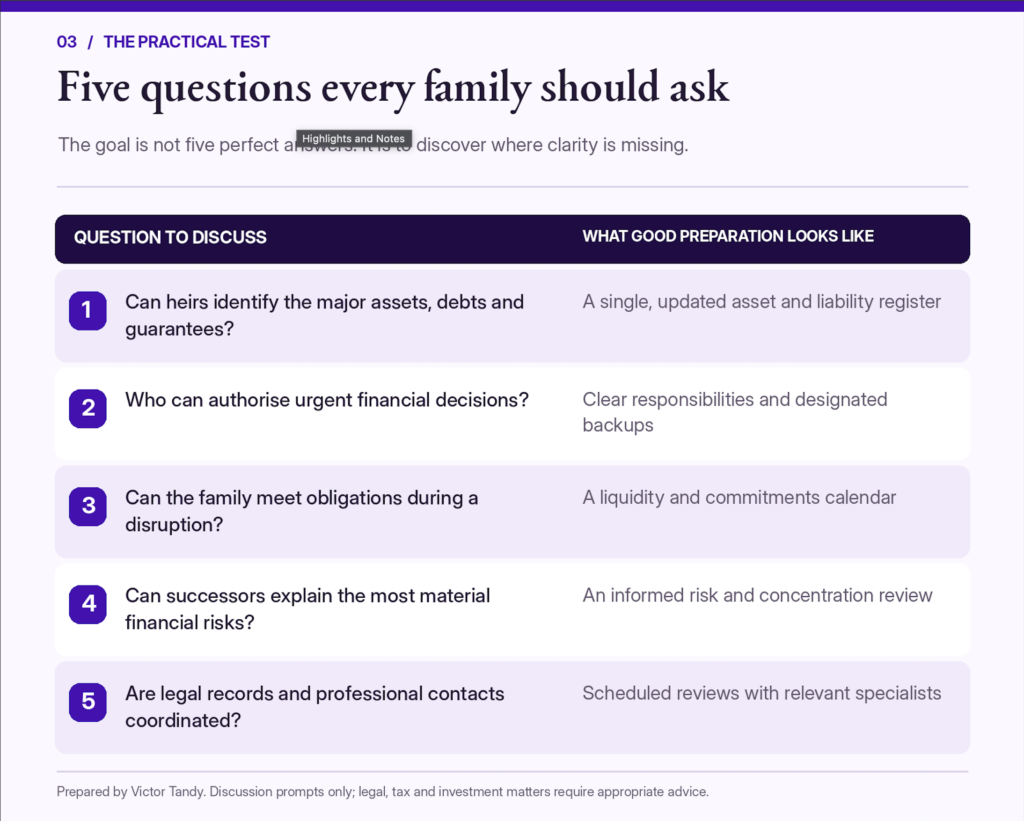
If these questions produce uncertainty, the next step is not necessarily another financial product.
It may be a better record, a clearer decision-rights map, a liquidity plan, or coordinated conversations among the family and its legal, tax and financial specialists.
The role of a Family CFO
A Family CFO perspective starts by looking across the full household and family-business financial picture—not just individual investment accounts.
It can help organise information, clarify obligations, document decision processes, coordinate relevant specialists and prepare the family for foreseeable transitions.
Legal ownership, tax treatment and formal authority still need to be determined and implemented by appropriately qualified professionals.
The ultimate goal is not merely to pass down wealth. It is to make responsible decisions possible after the person who created it is no longer making every call.
If you would like to review how prepared your family’s financial decision-making is for a future transition, you can book a conversation with me here:
Schedule a wealth-governance discussion: https://rebrand.ly/diagnose-your-wealth
— Victor Tandy
Founder & CEO, Tandy FinServ
Family CFO & Wealth Governance Specialist
Author: The Family CFO
Research references
- Julius Baer–EY, Indian Family Office Playbook, August 2026
- Julius Baer, Family Barometer 2026, 20 October 2026
- PwC India, 12th Family Business Survey, February 2026
Disclaimer: For general educational purposes only. This article does not constitute personalised investment, legal, tax or other regulated advice.
INSIGHTS. UPDATES. INSPIRATION.
Subscribe to Our Newsletter
Get the latest news, insights and updates delivered straight to your inbox.
Your email is saved securely. No spam, unsubscribe anytime.
