
What the Sunjay Kapur family dispute reveals about the limits of legal structures—and the importance of family wealth governance.
When a wealthy family has access to lawyers, financial professionals and sophisticated ownership structures, shouldn’t its legacy be easier to protect?
One might reasonably expect so.
Yet the legal proceedings involving the family of late industrialist Sunjay Kapur raise questions that deserve attention from business owners and wealthy families well beyond the people involved.
Sunjay Kapur, associated with the automotive-components business Sona Comstar, died on 12 June 2025.
Following his death, separate legal proceedings arose concerning his purported will and the family’s trust arrangements.
The disputes have attracted considerable public attention because of the individuals involved and the substantial business and financial interests associated with the family.
But beneath the headlines lies a more important financial-governance question.
Can a family have sophisticated legal arrangements and still lack the shared understanding, decision-making processes or alignment needed to manage wealth without conflict?
The answer, in principle, is yes.
And understanding why matters more than the size of the fortune.
What the Sunjay Kapur proceedings actually tell us
To understand the wider implications, we need to distinguish two sets of legal proceedings.
The dispute over the purported will
Sunjay Kapur’s children Samaira and Kiaan challenged a purported will dated 21 March 2025, which his widow Priya Kapur has maintained represents his wishes.
His mother, Rani Kapur, has also challenged aspects of the claimed inheritance arrangements.
The parties have presented differing accounts concerning the document and its validity.
On 30 April 2026, the Delhi High Court ordered preservation of specified assets while the legal proceedings continue.
Importantly, the court’s interim order did not finally determine whether the purported will is genuine or invalid. That remains a matter requiring adjudication.
The immediate judicial concern was preserving the relevant assets pending resolution of the dispute.
The separate family-trust dispute
Another set of proceedings concerns the RK Family Trust.
Rani Kapur has challenged aspects of its creation and the transfer of assets into the trust, making allegations that are disputed by the opposing parties.
In May 2026, the Supreme Court encouraged the parties to pursue mediation, with former Chief Justice of India D. Y. Chandrachud appointed as mediator.
On 6 August 2026, the Supreme Court recorded that six mediation sessions had taken place and that the parties were cooperating.
The Court allowed further discussions until 2 November and scheduled the matter for 26 November 2026.
At the time of writing, the publicly verified records reviewed do not establish a final resolution.
These are separate proceedings, and it would be inappropriate to treat the contested allegations as proven facts.
Nor can we conclude merely from the existence of litigation that the family’s professional advisers were negligent or that its legal structures were necessarily defective.
What the proceedings undeniably demonstrate is that substantial financial resources and the existence of formal arrangements do not make disagreements over wealth impossible.
And that is where the Family CFO perspective becomes relevant.
A family trust can serve a legal purpose. But it cannot guarantee agreement.
A trust can be an important part of a family’s financial and legal architecture.
Depending on its terms, a trust may identify beneficiaries, assign powers and responsibilities to trustees, and establish arrangements concerning the administration and distribution of assets.
A properly designed and administered trust can serve legitimate objectives relating to asset holding, continuity and the management of beneficiaries’ interests.
But a trust is not a guarantee of harmony.
Family members may disagree about whether arrangements are valid, how provisions should be interpreted, whether duties have been fulfilled or whether decisions reflect their understanding of the family’s intentions.
These disagreements may concern legal rights, historical transactions, personal expectations or questions of control.
Some may be resolved through discussion or mediation. Others require formal legal determination.
The fundamental distinction is that establishing a legal arrangement and maintaining an effective family-governance process are related, but different, responsibilities.
The three layers of family wealth governance
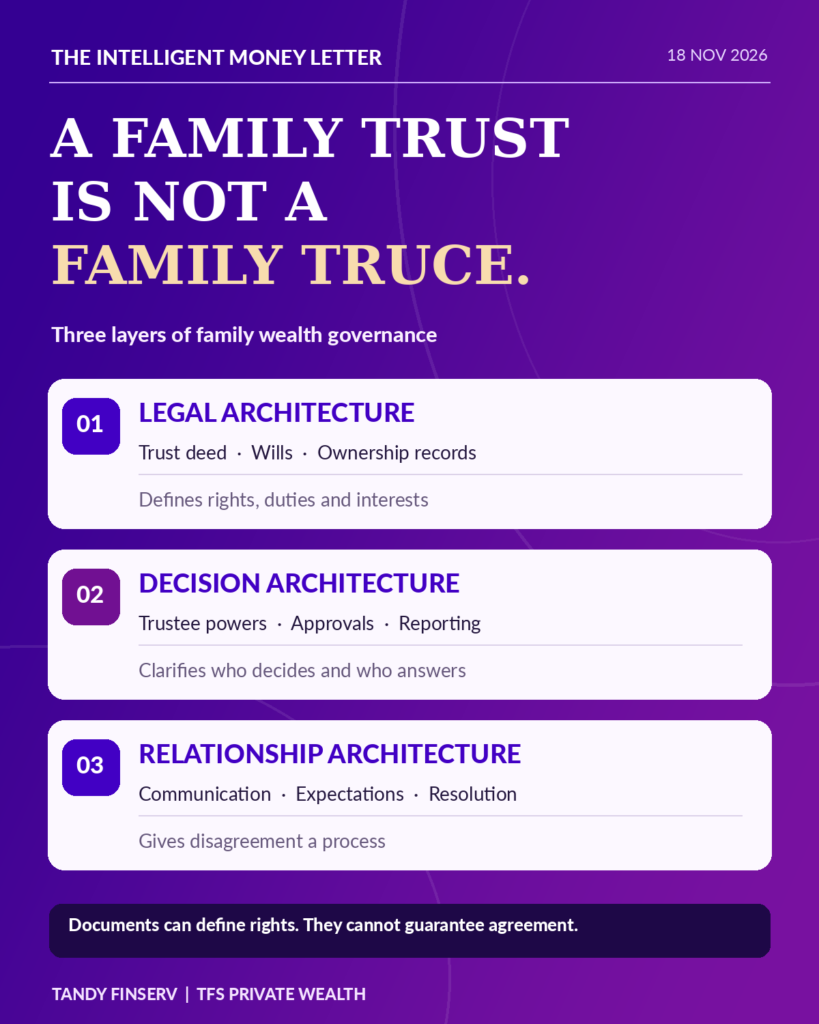
A useful way to understand this distinction is to examine three interconnected layers.
1. Legal architecture: What rights and obligations exist?
This includes wills, trust deeds, shareholder agreements, ownership records and other relevant legal arrangements.
Its purpose is to establish legally meaningful rights, duties, powers and restrictions.
For example:
- Who owns the family business shares?
- Which assets form part of a trust?
- Who are the trustees and beneficiaries?
- What powers do the relevant legal instruments grant?
- What consent or approval requirements apply?
These questions require careful legal documentation and qualified professional advice.
A family cannot replace legal certainty with informal understandings.
But legal documentation alone does not describe every practical process through which financial affairs are managed.
2. Decision architecture: Who makes decisions, and how?
Consider a family whose wealth includes operating businesses, investment entities, properties and a trust.
Different decisions may require different approvals.
A trustee may exercise powers defined by a trust deed. Directors must act within their corporate duties and legal authority. Shareholders may possess voting rights under applicable company law and agreements.
A family council or investment committee may also discuss broader family objectives, subject to the legal powers actually available.
The danger arises when people assume that influence, seniority, family relationships and legal authority are interchangeable.
They are not.
An effective decision architecture clarifies:
- Who is authorised to decide?
- Who must be consulted or informed?
- What documents must support the decision?
- How are decisions recorded?
- Who monitors implementation?
These procedures need to respect the actual legal arrangements rather than override them.
3. Relationship architecture: How does the family handle disagreement?
This is frequently the least formalised part of family wealth management.
Different family members can have entirely different expectations about what constitutes a fair or appropriate financial decision.
One may prioritise preserving a business.
Another may prefer diversification.
A third may want liquidity from an inherited interest.
Such differences do not necessarily indicate bad faith.
They may simply reflect different objectives, circumstances or understandings.
The challenge is establishing a process in which concerns can be communicated, legitimate rights respected and disagreements addressed before they become more disruptive.
That can include structured discussions, periodic information-sharing, agreed escalation procedures and access to independent mediation or professional advice where appropriate.
It cannot eliminate every future dispute.
But it can reduce the uncertainty surrounding how disagreements will be handled.
The missing distinction: Rights, responsibility and accountability
Imagine a hypothetical family holding assets worth ₹100 crore across businesses, property and financial investments.
Its legal arrangements may identify ownership interests and decision-making powers.
But suppose the family lacks a consistent process for recording major decisions, communicating information to the relevant people and reviewing changes in ownership or control.
Over time, different individuals may begin operating with different assumptions.
A decision that one person considers routine may be viewed by another as requiring consultation.
Information that one person regards as available may be difficult for another entitled party to obtain.
A change in family circumstances may not be reflected promptly in the family’s broader documentation and governance procedures.
None of this establishes that a legal instrument is invalid.
It illustrates a different problem.
The legal architecture may exist, while the day-to-day governance arrangements remain fragmented.
This is one reason family governance should be treated as an ongoing responsibility rather than a one-time documentation exercise.
Indeed, PwC’s 2026 Indian Family Business Survey highlights the importance of moving from informal, promoter-led practices towards clearer governance structures and codified decision-making.
Similarly, EY’s 2026 analysis of Indian family offices identifies growing attention to governance charters, investment committees, professional oversight and defined responsibilities.
The broader direction is clear: as wealth and family structures become more complex, the processes surrounding decisions matter increasingly.
Six questions every wealthy family should discuss
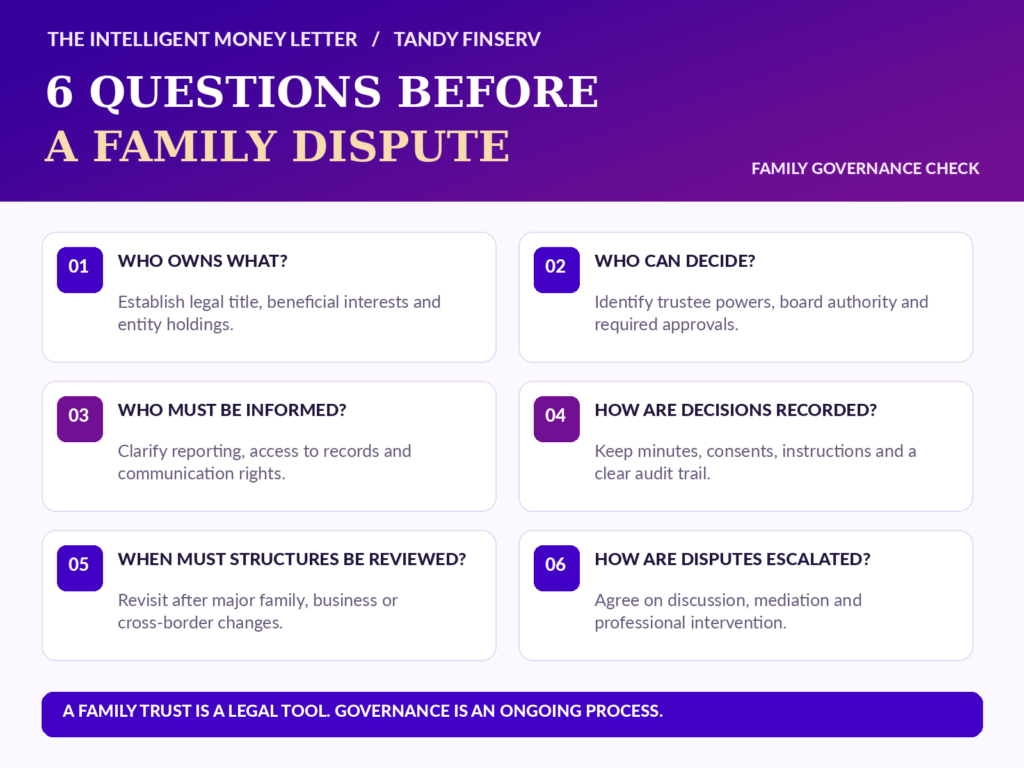
A useful starting point is a structured Family Governance Review.
- Who owns what?
Are ownership records, shareholding arrangements, trust interests and beneficial interests adequately documented and understood by the appropriate people?
- Who can decide?
Are trustee powers, corporate voting rights, approval requirements and the responsibilities of other decision-makers clearly identified?
- Who must be informed?
Do the relevant parties receive information consistent with their legal rights, governing documents and agreed reporting arrangements?
- How are decisions recorded?
Is there an accessible record of approvals, consents, major financial decisions, supporting advice and implementation responsibilities?
- When are arrangements reviewed?
Are relevant documents and procedures reconsidered following major changes such as deaths, marriages, business transactions, relocation or changes in law?
- How are disputes escalated?
Is there a recognised process for discussing concerns, involving independent professionals and pursuing mediation or other appropriate remedies?
These six questions are not a substitute for legal due diligence.
They are a practical way to identify whether important family-governance responsibilities are clearly assigned and regularly reviewed.
Where the Family CFO fits in
A Family CFO does not replace a lawyer, trustee, accountant or investment professional.
And a Family CFO cannot promise that family members will never disagree.
The role is different.
It is to help create a coordinated financial-governance system in which important information is organised, responsibilities are visible and unresolved issues receive appropriate attention.
For a business family, this may involve:
- Maintaining a consolidated record of family assets, liabilities, ownership and relevant structures.
- Coordinating with lawyers and tax professionals on documentation and outstanding questions.
- Tracking important financial decisions and identifying who is responsible for them.
- Establishing periodic reporting and review processes.
- Helping maintain clarity about liquidity, risk exposure and family financial commitments.
- Identifying circumstances where specialist intervention or updated documentation is needed.
Legal drafting, interpretation of rights and dispute resolution remain the responsibility of appropriately qualified professionals and lawful decision-makers.
The Family CFO contributes through visibility, coordination, follow-through and disciplined financial oversight.
Importantly, such a system should be established while relationships are functioning well—not only after a dispute arises.
Wealth can be transferred. Governance must be maintained.
The Sunjay Kapur proceedings may eventually produce judicial determinations, settlement arrangements or other outcomes.
Those results should not be anticipated or prejudged.
But irrespective of the outcome, the case raises a question that business owners and wealthy families would do well to consider.
Is the family relying solely on formal documents to manage complex financial relationships?
Or is there also a functioning system that clarifies authority, maintains appropriate records, coordinates professional responsibilities and provides a process for addressing disagreements?
A trust can form an important part of a family’s legal arrangements.
A family-governance system helps those arrangements operate with greater clarity and accountability.
Neither can guarantee the absence of conflict.
But together, supported by appropriate professional advice, they can contribute to more orderly financial decision-making.
Because building family wealth is an achievement. Creating the structures and processes to govern it responsibly is a separate responsibility.
Is your family wealth structured—but not fully coordinated?
At Tandy FinServ | TFS Private Wealth, our Family CFO approach helps business owners and wealthy families improve financial visibility, clarify responsibilities and coordinate with their existing professional advisers.
If your family’s wealth spans businesses, real estate, investments, holding entities or trust arrangements, a confidential conversation may help identify where greater financial-governance clarity is needed.
Diagnose Your Wealth — Book a Private Family CFO Conversation
Victor Tandy
Founder, Tandy FinServ | TFS Private Wealth
Wealth. Clarity. Legacy.
Research references
- Delhi High Court — Samaira Kapur & Anr. v. Priya Kapur & Ors., 30 April 2026
- Supreme Court — Rani Kapur v. Priya Sachdev Kapur, 6 August 2026
- PwC — 12th Family Business Survey, India, 2026
- EY — How Indian Family Offices Are a Rising Force in Private Capital Markets
Disclaimer: This article is intended for general educational purposes and does not constitute personalised investment, legal, tax or estate-planning advice. The legal proceedings discussed involve contested claims; no conclusion concerning alleged misconduct or document validity is implied. Legal rights and obligations depend on the facts, applicable law and relevant documents.
INSIGHTS. UPDATES. INSPIRATION.
Subscribe to Our Newsletter
Get the latest news, insights and updates delivered straight to your inbox.
Your email is saved securely. No spam, unsubscribe anytime.
