

The Intelligent Money Letter | 11 November 2026
The loan belongs to your company. The business makes the repayments. But whose wealth stands behind the borrowing?
For many entrepreneurs, borrowing is an important part of business expansion.
A manufacturer takes a working-capital facility. A growing enterprise finances new machinery. A founder raises debt to expand operations.
The lender assesses the company’s finances, creditworthiness and repayment capacity. The borrower signs the documents, the funds are disbursed, and the business moves forward.
But somewhere among the sanction letters, facility agreements and security documents, the promoter may also sign a personal guarantee.
Perhaps a privately owned property is offered as collateral.
These commitments can quietly change the financial relationship between the business and the family.
And that raises a question worth examining:
Could a borrowing decision made for your company create financial obligations that extend into your family’s personal wealth?
The answer is yes, under certain circumstances.

The business and the promoter are not the same legal person
A fundamental feature of an incorporated company is its separate legal identity.
Ordinarily, shareholders are not personally responsible for the company’s borrowings merely because they own shares or manage its affairs.
But that protection does not prevent an individual from voluntarily undertaking a separate legal obligation.
Consider a hypothetical situation.
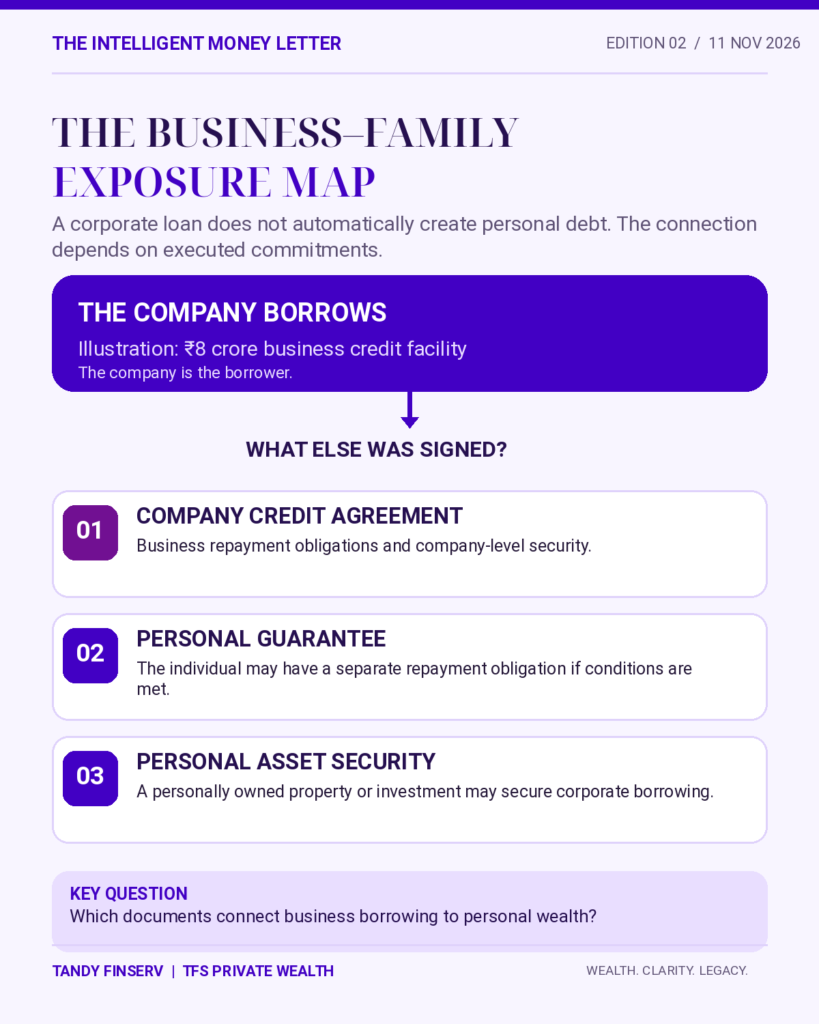
A manufacturing company obtains an ₹8 crore credit facility.
The promoter agrees to provide:
- A personal guarantee supporting the company’s repayment obligations.
- A mortgage over a personally owned commercial property valued at approximately ₹3 crore.
The company remains the borrower.
The promoter, however, may now face two different forms of exposure: a contractual obligation under the personal guarantee and the possible enforcement of the specified property security.
The ₹3 crore property does not create an additional ₹3 crore borrowing. Nor does its value necessarily limit the personal guarantee to ₹3 crore.
The actual exposure depends on the outstanding debt, the executed documents, any contractual limits, applicable law and recoveries already made.
The important distinction is between what the company owes and what the promoter has personally undertaken to support.
The two documents every promoter must understand
1. The personal guarantee
Under Section 128 of the Indian Contract Act, 1872, the liability of a surety is generally co-extensive with that of the principal debtor unless the contract provides otherwise.
In practical terms, a personal guarantee can create an enforceable obligation extending beyond the company itself.
Depending on the agreement and applicable law, a creditor may pursue a guarantor without first exhausting every recovery avenue against the company.
This is particularly relevant when a business encounters financial distress.
But not all guarantees are identical.
Some may contain monetary limits. Others may extend to a continuing series of transactions. The scope of interest, costs, renewals and release provisions can also differ.
A guarantee given several years earlier should not simply be assumed to have expired because the original loan period has ended.
Its continuing validity and enforceable extent must be assessed from the documents and relevant legal circumstances.
2. The security agreement
The second source of exposure is a pledge, mortgage or other security interest over personally owned assets.
A commercial property may secure a business facility. Shares may be pledged. Deposits or other eligible assets may be provided as collateral.
The consequences depend on the form of security, the rights created and the applicable enforcement process.
For example, a mortgage over a personally owned property may permit a secured creditor to enforce its security if the relevant legal and contractual requirements are satisfied.
The family may continue to use the property while the loan is performing.
That does not mean the property is free from restrictions or can necessarily be disposed of without satisfying the lender’s rights.
A property can remain legally owned by the family while simultaneously serving as security for a business obligation.
Why this deserves attention even when the business is doing well
A personal guarantee does not mean the promoter must immediately pay the company’s outstanding borrowing.
It may represent a contingent financial exposure rather than a current personal liability payable on demand.
However, its potential consequences deserve consideration when evaluating the family’s financial resilience.
Suppose a family owns several properties and a diversified investment portfolio.
Its financial statements may show substantial personal wealth.
But if material assets are mortgaged to support business borrowing, and the promoter has also given guarantees, the family needs to understand these commitments alongside the value of its holdings.
This does not necessarily change the family’s reported net worth immediately.
It changes the assessment of how that wealth could be affected under financial stress.
And it is precisely why an asset register and a liability register should be supported by a separate record of guarantees, security arrangements and other contingent exposures.
Five questions to ask before signing the next facility
1. Is the guarantee limited?
Does the guarantee have an explicit maximum amount? Is it restricted to a particular facility, or does it cover a broader set of obligations?
Review the principal amount, interest, costs and continuing-guarantee provisions with legal counsel.
2. Which personal assets are actually committed?
Identify every personally owned or jointly held asset that has been offered as security.
The answer should come from executed mortgage, pledge and security documents—not from assumptions about what the lender might hold.
3. What events could trigger enforcement?
Review the provisions concerning defaults, demands, guarantees and security enforcement.
A lender’s contractual rights and the statutory processes available to it may depend on the type of obligation and security.
4. What changes when the facility is renewed or increased?
A credit limit may be enhanced, restructured or renewed over several years.
Each significant change should prompt a review of whether existing guarantees and security continue, expand, change or require fresh consent.
The answer should never be assumed without examining the relevant documents.
5. When are these commitments formally released?
Repayment and release should not be treated as an informal understanding.
Obtain the appropriate confirmations, discharge documents and evidence that relevant security interests or registered charges have been satisfied, where applicable.
The objective is to establish what obligations have ended and what, if anything, remains.
A missing document in many family wealth records
Most business owners maintain records of company borrowings.
Many also track their personal investments, properties and outstanding household loans.
But a third record can be equally important:
The Promoter Personal Exposure Register.
This is not a statutory document or a substitute for legal review. It is a practical governance tool.
It should identify:
Information | What needs to be recorded |
Borrowing entity | Which company or business owes the debt |
Lender and facility | The lending institution, nature and status of the credit facility |
Personal guarantor | Who has signed a guarantee |
Guarantee terms | Scope, monetary limits, duration and material conditions |
Security provided | The personally owned or jointly owned assets committed |
Current obligations | Outstanding amounts and relevant contingent exposures |
Review responsibility | Who monitors renewals, changes and discharge documentation |
Consider the value of having this record updated whenever the business renews a facility, increases borrowing or changes its security arrangements.
It gives the family a clearer understanding of the commitments connecting its enterprises to personal finances.
It also helps its CA, legal counsel, bankers and other professionals work from a consistent record.
The Family CFO perspective: Growth and protection must coexist
A Family CFO approach does not treat business borrowing as inherently undesirable.
Debt can be a legitimate instrument for business growth, liquidity management and capital allocation.
The objective is not to discourage borrowing.
It is to understand its consequences across both business and personal finances.
A coordinated approach therefore asks:
What is the company borrowing?
Who is contractually responsible?
What family-owned assets are committed?
How might the family be affected if the business experiences stress?
Who monitors those commitments until they are formally discharged?
These questions require coordination between the company’s finance team, lenders, legal professionals and the people responsible for overseeing the family’s broader financial affairs.
The Family CFO contributes by maintaining visibility, organising relevant records, identifying unresolved questions and ensuring that the appropriate professionals are involved.
It does not replace legal advice, loan documentation review or the lender’s own credit processes.
The boundary worth protecting
A successful business can be one of a family’s most valuable economic assets.
Supporting that business with personal commitments may sometimes be a deliberate and commercially justified decision.
But the decision should be made with an understanding of its consequences—not merely as another signature required to complete the borrowing process.
Because a family can have substantial wealth, a profitable business and well-managed investments while still carrying financial exposures that are not immediately visible in its personal balance sheet.
Before asking how much more your business can borrow, ask how much of your family’s wealth is already supporting it.
Is your family’s wealth exposed to your business borrowings?
At Tandy FinServ | TFS Private Wealth, our Family CFO approach helps business owners establish a clearer view of their personal financial commitments, family assets and business-related exposures.
We coordinate with appropriate legal, tax, banking and financial professionals to support better visibility, documentation and decision-making.
If you own or manage a business with significant borrowing, personal guarantees or pledged assets, consider beginning with a confidential discussion.
Book a Private Family Wealth Conversation
Victor Tandy
Founder, Tandy FinServ | TFS Private Wealth
Wealth. Clarity. Legacy.
Disclaimer: This article is for general educational purposes and does not constitute personalised legal, tax, credit or investment advice. The extent and enforceability of guarantees and security interests depend on the specific documents, facts and applicable law. Seek appropriate professional advice before making decisions about borrowing, guarantees or asset security.
Research references
INSIGHTS. UPDATES. INSPIRATION.
Subscribe to Our Newsletter
Get the latest news, insights and updates delivered straight to your inbox.
Your email is saved securely. No spam, unsubscribe anytime.
