
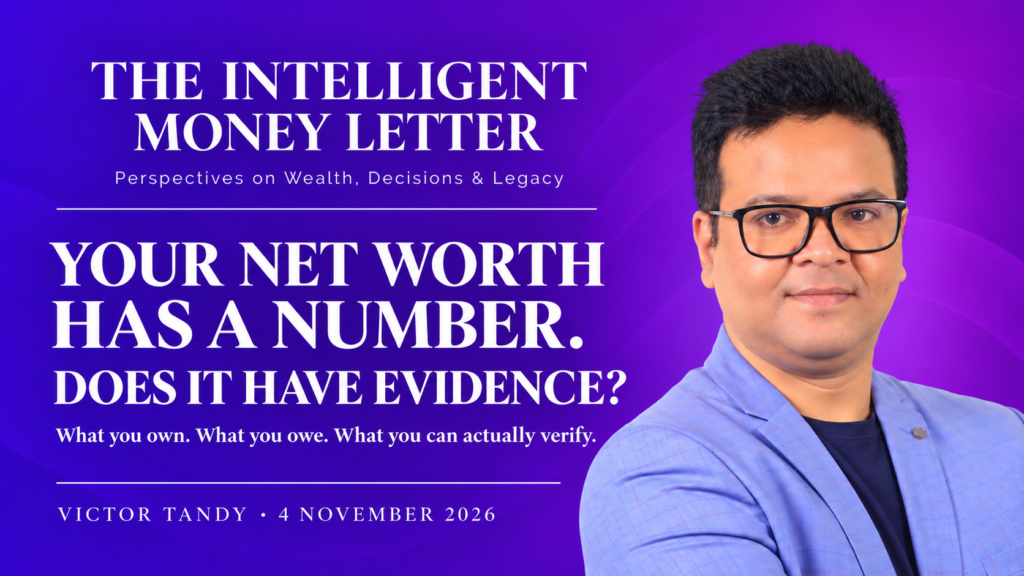
The Intelligent Money Letter | 4 November 2026
A ₹30 crore net worth may look impressive on paper. But what happens when someone asks you to substantiate it?
Imagine a business owner who estimates his family’s net worth at ₹30 crore.
He owns a successful business, two properties, financial investments and several bank accounts. He knows the approximate values and can readily calculate a total.
Now imagine asking him five questions:
- Who legally owns each asset, and in what proportion?
- When was each asset last valued, and on what basis?
- Which assets are pledged, mortgaged or otherwise restricted?
- Are all outstanding loans and financial obligations included?
- Can the family produce records supporting these answers?
Suddenly, a seemingly simple number becomes considerably more complicated.
This is an illustrative scenario, not an account of a particular client. But it reveals a fundamental distinction.
There is a difference between estimating your wealth and establishing a reliable financial picture of it.
The problem with a single net-worth number
Net worth is conventionally calculated by subtracting liabilities from assets.
The formula is straightforward.
But for wealthy families and business owners, the information going into that formula is rarely straightforward.
A residential property may be jointly owned. A commercial property may belong to a company rather than an individual. A business valuation may be based on assumptions that have since changed.
Some investments may be held through different entities. Certain assets may be pledged as collateral. Loans may have been repaid without the corresponding security documents being formally released.
And the business owner may have provided personal guarantees for corporate borrowing.
These details do not necessarily mean the family’s wealth is smaller than expected.
They mean a single estimated value may not adequately represent ownership, liquidity, obligations or exposure.
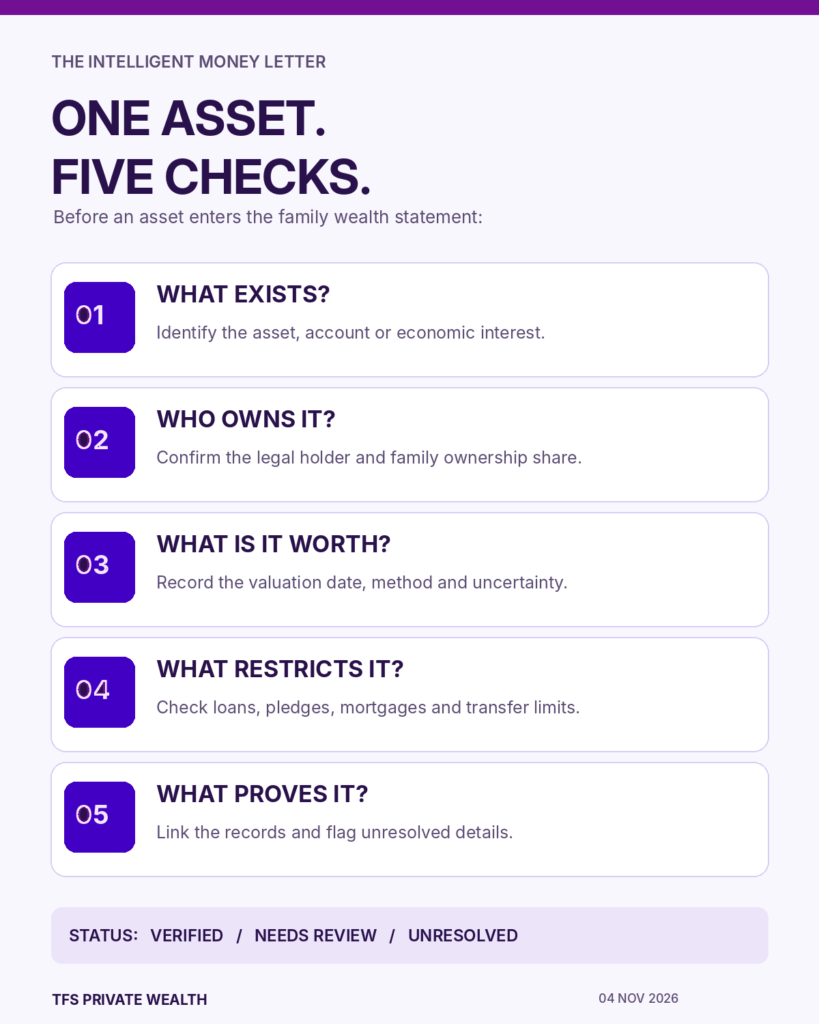
Five questions behind a credible Family Wealth Statement
1. What exactly does the family own?
Start with a comprehensive asset inventory.
Include financial investments, bank deposits, real estate, private-company shareholdings, partnership interests, significant receivables and other material assets.
Importantly, avoid counting the same economic interest twice.
For example, if the family owns shares in a private company, the company’s properties and investments should not automatically be added to the family’s personal assets. Those underlying assets may already be reflected in the valuation of its equity stake.
A reliable financial statement must distinguish between personal ownership, joint ownership and ownership through business or other legal entities.
2. Who has the legal rights to those assets?
Having access to an asset does not necessarily establish ownership.
A family may occupy a property owned by a company. An investment may be held jointly. A business interest may be subject to shareholder agreements or transfer restrictions.
Ownership records, shareholding documents, agreements and other relevant legal records help establish the rights associated with each holding.
Where legal title or beneficial ownership is uncertain, the matter requires examination by appropriately qualified legal professionals.
The person who uses an asset and the person who owns it may not be the same.
3. What is the asset reasonably worth today?
Different assets require different valuation approaches.
A listed security has an observable market price. A private business may require a valuation based on its financial performance, cash flows, comparable businesses and other assumptions.
Property values may depend on location, market conditions, tenancy, title and transaction circumstances.
An old purchase price, broker’s estimate or historical funding-round valuation is not necessarily a reliable representation of current realisable value.
For meaningful financial oversight, valuations should carry a date, methodology and indication of uncertainty.
Liquidity also matters. A valuable private-company stake cannot necessarily be converted into cash as readily as a bank deposit.
4. What does the family owe, and what could it become responsible for?
A complete financial picture cannot stop at the asset register.
It must incorporate outstanding mortgages, personal loans, loans against investments and other material liabilities.
Potential obligations also deserve attention.
For example, a promoter’s personal guarantee for a corporate facility may create a contingent exposure. It should be documented and assessed according to the executed agreement, even if it has not become an immediately payable personal debt.
A contingent guarantee should not automatically be subtracted from net worth as though it were an outstanding loan. But excluding it from the family’s risk picture altogether would also be misleading.
Likewise, pledged assets still require a clear record of the applicable restrictions and security arrangements.
An asset’s estimated value and the family’s unrestricted access to that value are two different things.
5. Can these figures be substantiated?
This is where an estimate begins to become an evidence-supported statement.
For listed securities and mutual funds, India’s Consolidated Account Statement (CAS) provides a consolidated view of eligible holdings and transactions. It is a useful source, but not a complete statement of family wealth.
Property documentation, corporate shareholding records, bank confirmations, loan statements, valuation reports and executed agreements help fill different parts of the picture.
The Reserve Bank of India also provides for individuals to access one free full credit report per calendar year from each credit information company holding their credit history.
Nevertheless, no single statement or portal captures every asset and liability of a complex family.
The objective is not to collect more paperwork. It is to reconcile reliable information into one consistent financial record.
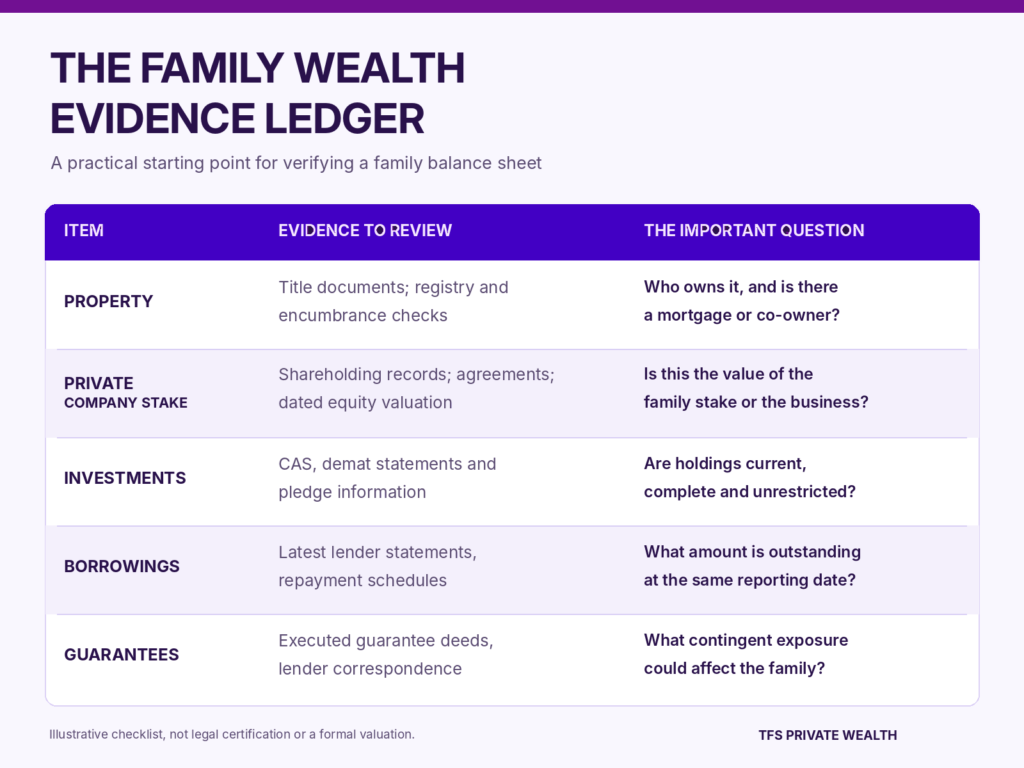
What a Family Wealth Statement should contain
A practical Family Wealth Statement should bring together the following information:
Component | What should be recorded |
Asset register | Asset description, holding entity and ownership share |
Valuation record | Estimated value, valuation date, source and assumptions |
Liabilities | Outstanding amount, borrower, lender and repayment obligations |
Encumbrances | Mortgages, pledges, charges and other relevant restrictions |
Supporting evidence | Location and status of ownership and financial records |
Verification status | Confirmed, requires review or unresolved |
This is a management and governance record, not a substitute for a statutory audit, legal title opinion or formal asset valuation.
Its value comes from identifying what is known, what is estimated and what remains unverified.
Three questions worth asking your family
Before your next major financial decision, consider:
First: If you needed to produce a consolidated record of your family’s assets and liabilities within 48 hours, could you do it?
Second: Do you know which assets are independently owned, jointly held, pledged or controlled through a business entity?
Third: When your family makes a significant financial decision, are you using information that has been reconciled and updated, or estimates collected from different sources?
If any answer is uncertain, that is a reason to examine the underlying information—not necessarily a reason to assume something is wrong.
Where the Family CFO fits in
A Family CFO approach begins by improving visibility across the family’s financial affairs.
It brings together records, reconciles information, identifies unresolved issues, assigns follow-up responsibilities and coordinates with the family’s CAs, lawyers, bankers, valuers and other relevant specialists.
The process helps create a single working picture that can be updated periodically and used to support more informed decisions.
It is not about replacing those professionals or claiming that one person can independently verify every legal or financial detail.
It is about ensuring that their work contributes to a coherent understanding of the family’s overall financial position.
After all, wealth is not merely a number to be calculated.
It is a collection of economic interests, ownership rights, obligations and decisions that need to be understood together.
Before asking how to grow your net worth, ask whether you can substantiate the one you already have.
A private conversation about your family’s financial clarity
At Tandy FinServ | TFS Private Wealth, our Family CFO approach helps business owners and wealthy families organise their financial information, identify documentation gaps and develop more coordinated wealth-governance arrangements.
If your financial affairs span businesses, real estate, investments and multiple professionals, a structured review may help establish where greater clarity is needed.
Book a confidential Family Wealth Clarity Conversation
Victor Tandy
Founder, Tandy FinServ | TFS Private Wealth
Wealth. Clarity. Legacy.
Disclaimer: This article is for general educational purposes. It is not personalised investment, tax or legal advice. Asset valuation, ownership rights, guarantees and other financial obligations require appropriate professional revi
INSIGHTS. UPDATES. INSPIRATION.
Subscribe to Our Newsletter
Get the latest news, insights and updates delivered straight to your inbox.
Your email is saved securely. No spam, unsubscribe anytime.
